 |
 |
 |
 |
|
|
|
|
Berlin, Dezember 1987
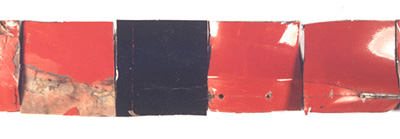
Karl Dietz, 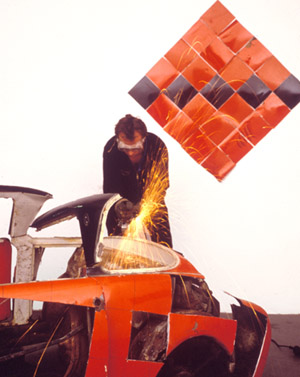 There´s an official view of Berlin art that focusses on the history and revival of expressionist painting. For a city which depends in some measure on tourism, the official view helps market Berlin’s nightlife, hotels and restaurants. But the official view can’t hide the fact that interest in neoimpressionism has here, as elsewhere, evaporated. Laden fuer Nichts (Store for Nothing) is a new artist run space which clearly rejects the market mentality of the official brush-stroke and drip school.Their first exhibition gives the space to a Berlin art, Karl Dietz, who works with cars. 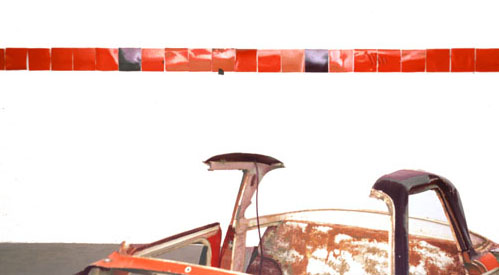 Dietz sees himself in the constructivist-minimal tradition, working with abstract form in specific environments. At Laden fuer Nichts, on successive evenings, he cut up a 1961 Gogomobil. After drawing a grid of uniform 20 cm squares on all the flat surfaces of the automobile, he cut them out and mounted them on the wall in a series of changing configurations which addressed the proportions of the gallery space - finishing with a line that extended all around the gallery walls at eye level. The frame of the Gogomobile was left in the center of the space. A sports car for the masses that was popular in the early sixties, the Gogomobil is itself the bearer of considerable inferences and associations.It came to epitomize the Americanization and affluence of the post-war Germany of “the new Beginning”. It is also an example of the redeployment of the technical know-how acquired during the war from the manufacture of arms to the organization of leisure-post-war capitalism’s last great frontier.
This particular Gogomobile, however, had in its history been repainted a brilliant revolutionary vermillion and anarchist black. Dietz is reminding us of the revolutionary origins of constructivism when the “organization of life” was a priority for the arts. Like the early constructivist, Dietz divorces his material from an associative function - the metal squares are, finally, an articulation of the gallery space which is inde pendent of the automobile. But he also leaves his somewhat violent process in evidence. No doubt, this violence (perhaps not an altogether homage to his one-time teacher, Hermann Nitsch), is to be taken as an antitechnogical gesture. It is an reaction against the kind of individualism and consumerism that the Gogomobile represents. Scott Watson, Berlin/Vancouver, 1987 |